


The Imago Dei (Image of God) is not a physical or spiritual possession like a soul; it is a biblical description of the human vocation to act as God’s functional representative, reflecting His wise and loving rule into the creation.
Have you ever noticed how easily we ruin beautiful words by turning them into dusty, academic furniture?
Take a phrase like “the image of God.” If you have spent any time in church, you have likely heard it tossed around. We use it to defend human rights, to explain why murder is wrong, or to console ourselves that we are somehow “special.” But if you press the average person on what it actually means, the conversation usually goes rather hazy.
Some will tell you it means we have a “soul”—a sort of ghostly, invisible passenger riding inside our physical bodies. Others will say it means we have a mind, or a conscience, or the ability to write poetry. The trouble with all these answers is that they treat the “image” like a possession. We speak of it as if God, at the moment of creation, slipped a shiny, spiritual gold coin into the pocket of human nature, and that coin is what makes us valuable.
But what if the image of God is not a coin we carry in our pockets at all? What if it is more like a job we were hired to do—or, better yet, a mirror we were designed to be?
1. What Is the "Image of God" (Imago Dei) in the Bible?
To understand what the ancient Hebrews meant when they wrote about the “image of God,” we have to step out of our modern libraries and walk into the dusty air of the ancient Near East.
Imagine you are a peasant living in a remote province of a vast empire. The Emperor lives hundreds of miles away in a golden palace you will never see. How do you know you are still under his rule? How do you know where his territory begins and ends?
The answer is simple: you walk into the town square and look at the statue.
In the ancient world, an emperor or king would erect a physical statue of himself—what the Hebrews called a tselem—in the farthest reaches of his conquered lands. That statue stood where the king could not physically be present. It was a concrete claim of sovereign authority over that region. If you defaced the statue, you were declaring war on the king. If you honored the statue, you were submitting to his reign.
Now, here is the breathtaking thing. When the author of Genesis sits down to describe how God built the universe, he uses that exact imperial language. God constructs a massive, cosmic temple—the heavens and the earth—and then He does something that would have made every ancient pagan gasp. He does not place a statue of gold or stone in His temple. Instead, He says:
“Let Us make man in Our image (tselem), according to Our likeness (demuth)...” (Genesis 1:26, LSB)
Do you see the point? God did not want a cold, static piece of metal representing Him. He chose a living, breathing, walking representative. You are the statue. You were placed in this world to stand at the boundary line of heaven and earth, reflecting the wise, loving rule of the Creator into the creation, and reflecting the worship of the creation back to the Creator.
This explains why one of the Ten Commandments is so fiercely stubborn about forbidding physical idols:
“You shall not make for yourself an idol, or any likeness of what is in heaven above or on the earth beneath...” (Exodus 20:4, LSB)
It is not because God is allergic to art. It is because He had already made His own living, breathing images! To carve a static idol out of wood and bow down to it is like ignoring a living, loving wife to kiss a crude, wooden puppet you made in her likeness. It is a monstrous demotion.
Now, the Hebrews used two words here: image (tselem) and likeness (demuth). Think of it this way. Tselem is the job description—the physical representative standing in the territory. Demuth is the family resemblance—the check that keeps us from thinking we are God. We are like Him, but we are not Him. We are reflections, not the Light itself.
2. Why the Image of God Is More Than Just a Soul
Before we go any further, we must clear up a massive misunderstanding that has clouded Christian thinking for centuries. It is the old Greek habit of dividing a human being into neat, separate compartments: a mortal body, an immortal soul, and a mind.
When we inherit this Hellenistic view, we begin to think that only the “invisible” part of us—our mind or our soul—is made in the image of God, while our physical bodies are just a temporary, rather troublesome tin can we get to discard at death.
But the Hebrew mind did not think this way at all. To the Hebrew, a human being is a unified whole. You do not have a soul; you are a living soul. Your physical body is not an accidental container; it is the very platform upon which your divine job is carried out.
Let us look at it this way. Imagine an ambassador sent to represent her country in a foreign land. She needs a physical office, a voice to speak, and papers to sign. If you strip away her ability to speak, act, or write, she ceases to function as an ambassador. In the same way, you cannot separate your “substance” (your physical, rational, embodied self) from your “vocation” (your job as God’s representative).
We must not make the mistake of anthropomorphizing God—believing that because we are in His image, God must have physical eyes, ears, and feet like we do. God is Spirit. But we must also avoid the opposite mistake—believing that our physical, everyday work of building, creating, cooking, designing, and governing does not matter to God. We are called to “look like” God not by our physical shape, but by our functional form—by acting with His love, His justice, and His creative wisdom on earth.
3. What Does the Fall Mean for Our Human Vocation?
This brings us to the tragedy we call the Fall.
The serpent’s lie in the Garden of Eden was a masterpiece of psychological sabotage. He whispered:
“For God knows that in the day you eat from it your eyes will be opened, and you will be like God, knowing good and evil.” (Genesis 3:5, LSB)
Here is the supreme irony: Adam and Eve already were like God! They were already crowned as His vice-regents. But the tempter convinced them that they were missing out, that their dependence on God was a cage rather than their source of life. He tempted them to step outside their representative role and try to become independent sovereigns.
The trouble with trying to be your own god is that it is a metaphysical impossibility. We are mirrors. A mirror has no light of its own; it can only reflect the light of the sun. What happens if the mirror decides it is tired of relying on the sun and wants to generate its own light? It must turn inward, away from the sky, to look at itself. And what does it reflect then? Nothing but darkness.
By cutting ourselves off from the Creator, humanity entered what we might call a self-cannibalizing state.
Picture a potted plant that decides it no longer wants to depend on the soil and water provided by the gardener. It pulls its own roots out of the dirt and begins to burn its own leaves to keep itself warm. For a few moments, it might produce a tiny, flickering warmth. But it is consuming its own substance to survive. It is a dying, parasitic thing.
That is the state of human sin. Without the divine life-force fueling us, we began to devour our own relationships, our own bodies, and our own planet in a desperate, frantic attempt to sustain our own autonomous life.
In this light, God’s decision to banish humanity from the Garden and bar access to the Tree of Life was not an act of vindictive anger. It was a rescue mission. To let a self-cannibalizing human eat from the Tree of Life and live forever would be to immortalize our agony. It would be like keeping a terminal cancer patient alive forever without curing the disease. God put us outside the Garden so we would reach our physical limits, recognize our absolute bankruptcy, and cry out for a Savior.
4. How Jesus Restores Our Role as the Image of God
So, how does God repair a broken, self-cannibalizing mirror?
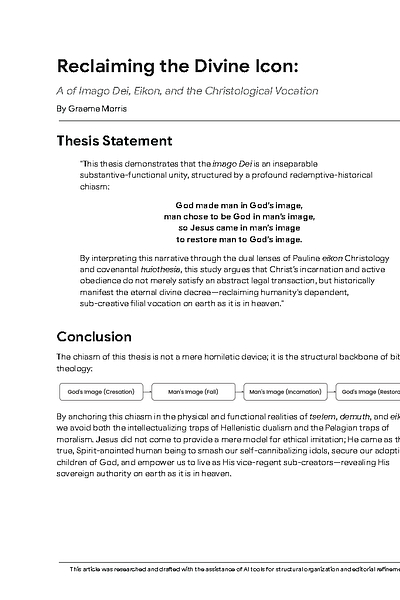
He does not do it by issuing a new set of rules from heaven. He does it by stepping into the world of mirrors Himself. He constructs a beautiful, historical chiasm:
God made man in God’s image, man chose to be God in man’s image, so Jesus came in man’s image to restore man to God’s image.
Jesus did not arrive as a superhero with a magic wand to execute a dry, legal transaction on a cosmic clipboard. He entered human history to systematically reverse the lie of Eden through four radical, historical step-changes.
Step 1: The Vulnerable Infant (The Stripping of Self-Sustenance)
The first step-change is the voluntary surrender of autonomous power. While Adam grasped for equality with God to feed his own ego, Christ did the exact opposite:
“...who, although existing in the form of God, did not regard equality with God a thing to be grasped, but emptied Himself, taking the form of a slave, being made in the likeness of men.” (Philippians 2:6–7, LSB)
Jesus entered creation not as a towering giant, but as a helpless, crying baby. Think of the staggering humility of this! The One who sustains the galaxies chose a state where He had no self-sustenance whatsoever. He could not feed Himself, protect Himself, or even hold up His own head without a human caregiver.
This was the ultimate “proof-of-concept.” Jesus demonstrated that being truly human does not mean being independent; it means being perfectly, beautifully dependent on the Father’s covering.
Step 2: The Jordan Baptism (The New Genesis)
The second step-change occurs when Jesus is baptized in the Jordan River:
“...and behold, the heavens were opened, and he saw the Spirit of God descending like a dove and coming upon Him...” (Matthew 3:16, LSB)
If you know your Bible, this scene should make your spine tingle. It is a deliberate, dramatic replay of Genesis 1. In the beginning, the Spirit of God was hovering over the dark, chaotic waters, waiting for the Word to bring forth creation. Now, at the Jordan, the Spirit hovers over the waters once more, and the Father’s voice declares His absolute pleasure in the Son.
Before Jesus has performed a single miracle or died on the cross, the Father declares Him to be the perfect, pleasing Son. This is the inauguration of the New Genesis. Jesus is standing there as the first truly “in-tune” human, showing us what life in Eden was always supposed to look like.
Step 3: The Spirit-Anointed Prototype (Acts 10:38)
The third step-change is Jesus’s active, everyday life. He did not walk around performing miracles by pulling secret, divine levers hidden under His human coat. He lived as a man entirely dependent on the Holy Spirit. As Peter preached:
“You know of Jesus of Nazareth, how God anointed Him with the Holy Spirit and with power, and how He went about doing good and healing all who were oppressed by the devil, for God was with Him.” (Acts 10:38, LSB)
This is what theologians call Christ’s “active obedience.” He was showing us the prototype of restored human function. As God’s living icon, He marched through a world occupied by the deceiver, reclaiming territory not by military violence, but by “doing good and healing.” His life was the ultimate demonstration of what a human being looks like when they are fully plugged into the Source of Life.
Step 4: The John 17 Commission (The Restoration of the Corporate Body)
The final step-change is the most exciting one of all, because it involves you.
On the night before His crucifixion, Jesus prays a radical prayer for His disciples—and, by extension, for all of us:
“The glory which You have given Me I have given to them, that they may be one, just as We are one; I in them and You in Me...” (John 17:22–23, LSB)
What is this “glory”? It is the royal-priestly job of bearing the divine image! Jesus does not keep His perfect image-bearing identity to Himself. Through His death, resurrection, and the subsequent outpouring of the Holy Spirit at Pentecost, He shatters our self-cannibalizing loop and shares His identity with us.
5. Getting Your Job Back
This is the heart of the Christian gospel. Salvation is not merely a ticket to a celestial retirement home when you die. It is the restoration of your original, cosmic vocation.
Through Jesus, you are adopted into the family business. You are filled with the very same Spirit that hovered over the Jordan and empowered Jesus to heal the broken. You are sent out into your neighborhood, your office, your school, and your art studio to:
Reclaim the Territory: Pushing back the darkness of selfishness, greed, and despair by living out the generous, others-centered love of God.
Cultivate and Create: Designing environments, building relationships, and structuring businesses that reflect the beauty, justice, and order of the Creator.
Live in Radical Dependence: Giving up the exhausting, burning-your-own-leaves struggle of self-sufficiency, and learning to breathe in the daily covering and grace of the Father.
The great mirror of your humanity has been cleaned, polished, and turned back toward the Sun. The question is no longer, “Can we be like God?” The answer has already been lived out in history. The question now is: will you step into the world today as His living icon, representing His sovereign, healing love on earth as it is in heaven?
Bibliography
Grudem, Wayne A. Systematic Theology: An Introduction to Biblical Doctrine. 2nd ed. Grand Rapids, MI: Zondervan Academic, 2020.
Keller, Timothy. Counterfeit Gods: The Empty Promises of Money, Sex, and Power, and the Only Hope That Matters. New York: Dutton, 2009.
Mackie, Tim. “The Imago Dei.” The Bible Project. Accessed June 11, 2026.
Wright, N. T. Paul and the Faithfulness of God. Minneapolis: Fortress Press, 2013.
Study Notes
Download My Study Notes
Other Articles like this:
How Jesus Redeems Our Divine Likeness

We were created to reflect the character of God, yet sin has distorted that divine likeness. In How Jesus Redeems Our Divine Likeness, I explore how the incarnation of Jesus offers a path to restoration, inviting us to move past abstract theology and into a life of relational submission where we truly embody His image once again.
Symbiosis

God made us in His image; Jesus prayed we’d be one with Him. God is not looking for parasites who eat at another’s table, but symbiosis: those who live life together.


