


Quick Summary: The 4 Steps of Lectio Divina
This is part of our series on Inward Spiritual Disciplines—read our previous guide on Breath Prayer.
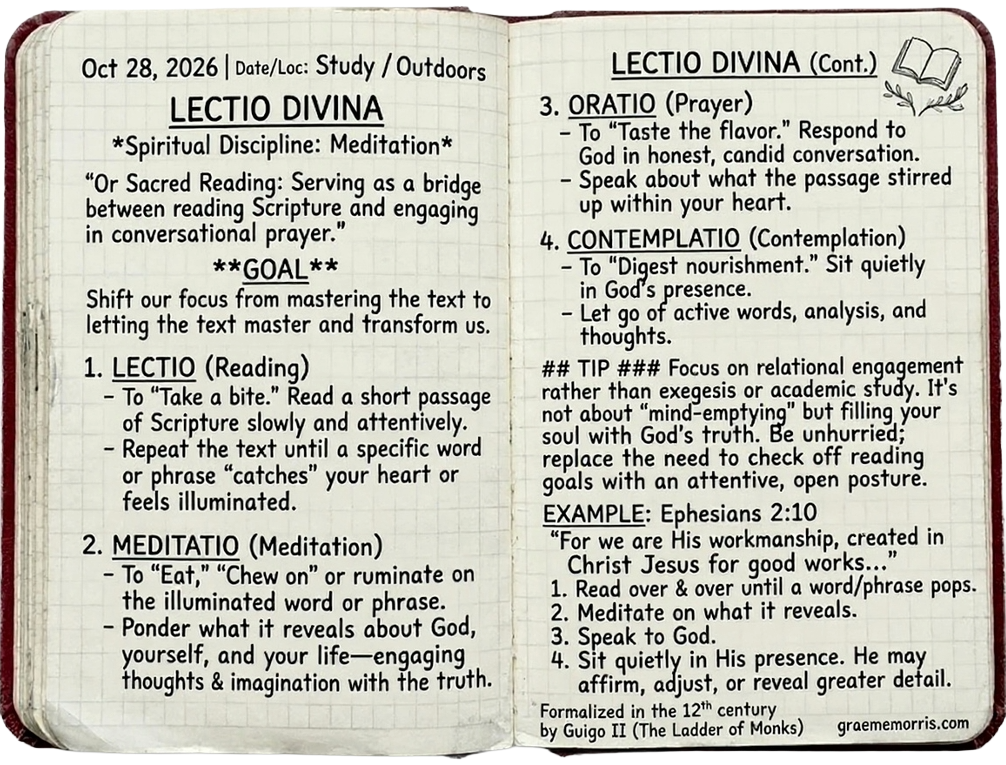
Lectio Divina1 or Sacred Reading is an ancient spiritual discipline that transforms scripture reading into a conversational prayer with God. Serving as a bridge between reading Scripture and engaging in conversational prayer with God. The practice follows four sequential steps:
Lectio (Read): Slowly read a passage until a specific word or phrase catches your heart.
Meditatio (Meditate): Ruminate and “chew on” the illuminated word to see what it reveals.
Oratio (Pray): Speak honestly to God in response to what the text stirred within you.
Contemplatio (Contemplate): Sit quietly and rest in God’s presence without active analysis.
Why Practice Lectio Divina?
The practice of resting in God’s presence and allowing His Word to permeate the heart so that we hear His instruction and respond in obedience. It transforms scripture reading from a mere intellectual exercise into a living, palpable encounter.
Goal:
Shift our focus from mastering the text to
letting the text master and transform us.
How to Practice Lectio Divina: A 4-Step Guide to Sacred Reading.
Step 1: Lectio (Reading)
To “Take a bite.” Read a short passage of Scripture slowly and attentively. Repeat the text until a specific word or phrase “catches” your heart or feels illuminated by the Holy Spirit.
Step 2: Meditatio (Meditation)
To “Eat” or “Chew on” or ruminate on the illuminated word or phrase. Ponder what it reveals about God, yourself, and your life, engaging your thoughts and imagination with the truth.
Step 3: Oratio (Prayer)
To “Taste the flavor.” Respond to God in honest conversation. Speak candidly to Him about what the passage stirred up within your heart.
Step 4: Contemplatio (Contemplation)
To “Digestion Nourishment.” Sit quietly in God’s presence, letting go of active words, analysis, and thoughts.
Pro Tip
Not Academic Study: Focuses on relational engagement rather than exegesis or grammatical analysis.
Not “Mind-Emptying”: Fills the soul with God’s truth rather than emptying it.
Not Legalistic: Replaces checking off reading goals with an unhurried, quality-focused posture.
Example
Ephesians 2:10 LSB (Legacy Standard Bible):
For we are His workmanship, created in Christ Jesus for good works, which God prepared beforehand so that we would walk in them.
Read it over an over till a word or phrase pops up in your mind
Meditate on what it reveals about God, yourself, and your life, engaging your thoughts and imagination with the truth.
Speak to God about what that word/phrase stirred up in your heart.
Sit quietly in the moment with God. Sometimes you will hear Him affirm you, adjust you, and or reveal a greater detail from the word/phrase.
Other Disciplines


Formalized in the 12th century by Carthusian monk Guigo II (Scala Claustralium / “The Ladder of Monks”)